

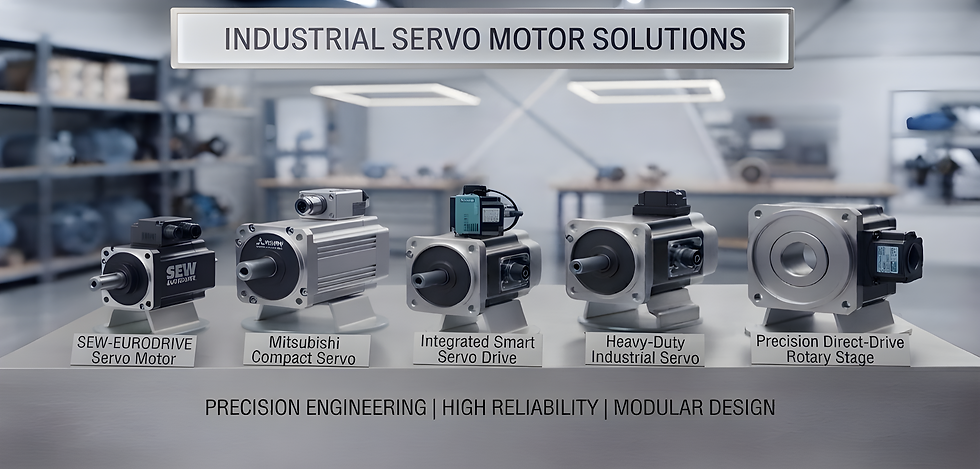
Servo Motors
Precision Servo Drive
Servo Motors
Servo motors are a class of motors that are designed to provide precise control of angular or linear position, velocity, and acceleration. These motors are widely used in applications that require high accuracy and reliability, such as robotics, CNC machinery, conveyor systems, and aerospace technologies. The unique capabilities of servo motors stem from their advanced closed-loop feedback systems, which enable them to adjust their performance in real-time based on the input they receive.
High-Precision Motion
One of the defining features of servo motors is their ability to achieve high-precision motion. This precision is made possible through the incorporation of advanced feedback mechanisms, such as encoders and resolvers, which continuously monitor the motor's position and speed. By comparing the actual position of the motor to the desired position, the control system can make instantaneous adjustments, ensuring that the motor reaches its target with minimal deviation. This level of accuracy is essential in applications where even slight errors can lead to significant issues.
Advanced Closed-Loop Feedback
The closed-loop feedback system is a critical component of servo motors. Unlike open-loop systems, where the output is not monitored or adjusted, closed-loop systems provide real-time feedback. This feedback allows for continuous adjustments based on the motor's performance. The key components of a closed-loop system include:
Encoder: A device that provides information about the motor's position and speed, allowing for precise control.
Controller: The brain of the system, which processes the input signals and determines the necessary adjustments to achieve the desired performance.
Motor Driver: Converts the control signals from the controller into electrical power, driving the motor to achieve the specified motion.
This combination of components ensures that servo motors can maintain high levels of performance even in dynamic environments.
Ultra-Responsive Dynamic Control
Servo motors are engineered for ultra-responsive dynamic control, which is essential in applications that require rapid changes in speed and direction. The ability to respond quickly to changes in input signals allows servo motors to perform complex tasks with ease. This responsiveness is particularly important in robotics, where precise movements are necessary for tasks such as assembly, welding, and painting. The dynamic control capabilities of servo motors are enhanced by their design, which typically includes:
High Torque: Servo motors are capable of delivering high torque at various speeds, making them suitable for heavy-duty applications.
Fast Acceleration: The ability to quickly accelerate and decelerate allows for more efficient operation and reduced cycle times.
Smooth Operation: Advanced control algorithms ensure that movements are smooth and free of jerks, which is crucial for maintaining the integrity of the machinery and the quality of the finished product.
Exact Positioning Accuracy
Exact positioning accuracy is a hallmark of servo motors. The combination of high-resolution encoders and sophisticated control algorithms enables these motors to achieve remarkable levels of precision. In many applications, servo motors can position components within fractions of a degree, making them ideal for tasks that require meticulous alignment. This accuracy is particularly beneficial in industries such as:
Manufacturing: In processes like CNC machining, precise positioning is vital for producing high-quality parts.
Aerospace: Servo motors are used in flight control systems where exact movements are crucial for safety and performance.
Medical Equipment: In devices such as surgical robots, precision is key to ensuring successful outcomes.
High-Torque Execution
High-torque execution is another significant advantage of servo motors. These motors can generate substantial torque at both low and high speeds, making them suitable for a wide range of applications. The high torque allows servo motors to handle heavy loads and perform demanding tasks without compromising performance. Applications that benefit from high-torque execution include:
Industrial Automation: Servo motors are often used in automated systems to move heavy components and materials.
Robotics: In robotic arms, high torque is necessary for lifting and manipulating objects of varying weights.
Conveyor Systems: Servo motors drive conveyor belts, ensuring smooth and efficient material handling.
Pinpoint Acceleration and Flawless Machinery Synchronization
Pinpoint acceleration is crucial for applications that require rapid changes in speed without overshooting or oscillation. Servo motors excel in this area, allowing for precise control over acceleration profiles. This capability ensures that machinery operates smoothly and efficiently, reducing wear and tear on components. Flawless machinery synchronization is essential in systems where multiple motors must operate in harmony. Servo motors can be synchronized through advanced control techniques, ensuring that all components move together seamlessly. This synchronization is vital in applications such as:
Multi-Axis CNC Machines: Where multiple axes must coordinate for precise machining.
Robotic Systems: In which multiple joints must work together to achieve complex movements.
Assembly Lines: Where various machines need to operate in concert for efficient production.